
Corona de Cristo: The Passion Vine That Blooms with Sacred History
, by Austin Parker, 5 min reading time
, by Austin Parker, 5 min reading time
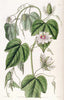
Drive through South Texas in late summer — the brush country south of San Antonio, thesandy flats near the coast, the saline low spots where most things struggle to survive —and you might catch a glimpse of something delicate climbing through the scrub. A thin,twining vine with leaves that smell faintly sour when you brush against them. Purpleflowers that open for just a few hours before closing again. It's easy to miss. Most peopledo. But Passiflora foetida, known locally as Corona de Cristo, is native to South Texas, andit carries with it a story that's part natural history, part religious symbolism, and part folkmedicine.
Corona de Cristo: The Passion Vine That Blooms with Sacred History
Drive through South Texas in late summer — the brush country south of San Antonio, the
sandy flats near the coast, the saline low spots where most things struggle to survive —
and you might catch a glimpse of something delicate climbing through the scrub. A thin,
twining vine with leaves that smell faintly sour when you brush against them. Purple
flowers that open for just a few hours before closing again. It's easy to miss. Most people
do. But Passiflora foetida, known locally as Corona de Cristo, is native to South Texas, and
it carries with it a story that's part natural history, part religious symbolism, and part folk
medicine.
The plant itself is modest. A delicate twining vine with an unpleasant smell, it has large
purple flowers that are showy but open for just a few hours. The reddish fruits contain a
somewhat sweet flavored pulp, and the leaves emit a spicy odor when damaged. It grows
in thickets, ditches, and meadows in sands and saline low spots — the kinds of places
where water is scarce and soil is poor. A plant adapted to extremity, like so much else that
survives in South Texas.
The Name and the Missionaries
But there's something unusual about this plant: its common name carries theology.
Corona de Cristo — Crown of Christ. The name didn't come from the indigenous peoples of South Texas or from European botanists cataloging New World plants. It came from
Spanish Christian missionaries.
Roman Catholic priests in the late 1500s believed that the petals, rays and sepals of the
passionflower symbolized the crucifixion. By the 1600s, Spanish Christian missionaries
had cultivated a narrative around Corona de Cristo, interpreting the Passiflora flower as a
visual representation of Christ's suffering. Known by the Spanish as "La Flor de las Cincos
Llagas" — "The Flower with Five Wounds" — the passion flower refers to Christ's suffering.
The unique floral structure and the numbers of its parts were used by Spanish missionaries
to teach Christian doctrine.
It's a remarkable example of how European colonizers imposed their own symbolic
frameworks onto the plants they encountered — turning a native vine into a teaching tool, a living sermon. The plant itself didn't change. But its meaning, at least in the eyes of those
with power to name things, shifted entirely.
The Vine in South Texas Today
Today, Corona de Cristo remains part of the South Texas landscape, though its status is
complicated. The plant is native to southern Texas, but it's also naturalized in Texas and
considered invasive in some contexts. It does well in the harsh conditions of South Texas
— it thrives in sand, loam, dry and saline soils — which means it can spread aggressively in
disturbed areas. The line between "native plant" and "invasive species" is often blurry, and
Corona de Cristo walks that line.
The Medicinal Tradition
Beyond the religious symbolism and the ecological complexity, Corona de Cristo has a
practical history. The plant is widely grown as a perennial climber and has been used in
traditional medicine. Like other Passiflora species, it contains compounds that affect the
nervous system. Patients use this herb to treat insomnia, anxiety, epilepsy, neuralgia, and
withdrawal syndromes from opiates or benzodiazepines. Research has documented that
the plant extract has analgesic and antidiarrhoeal activities, supporting its uses in
traditional medicine.
In South Texas, where folk medicine traditions blend indigenous knowledge, Spanish
colonial practice, and generations of local experimentation, Corona de Cristo would have
been available and accessible to anyone who knew where to look for it. Whether it was
used medicinally by the people living in South Texas before European contact, or whether
that practice developed later as Spanish and Mexican traditions mixed with indigenous
knowledge, isn't entirely clear from the historical record. But the plant was there, and it
worked for something.
What the Name Obscures
There's something worth sitting with in the story of Corona de Cristo. The common name —Crown of Christ—is poetic and carries centuries of religious meaning. But the plant is also called Stinking Passionflower, Fetid Passionflower, bush passion fruit, wild maracuja, wild water lemon, love-in-a-mist, and running pop, depending on where you are and who you're talking to. Each name tells a different story. Corona de Cristo tells you about Spanish missionaries and European theology. Stinking Passionflower tells you about the plant's actual smell. Love-in-a-mist speaks to something more poetic and less certain.
The plant doesn't care what we call it. It grows in the sandy soil of South Texas, flowers for
a few hours, and produces fruit that tastes slightly sweet. It's been used for medicine,
eaten for food, and transformed by human meaning-making into a symbol of suffering and redemption. It's both native and invasive, depending on the perspective. It's a good
example of how the same plant can hold multiple truths at once — ecological, spiritual,
medicinal, practical — and how the names we give things often reveal more about
ourselves than about the thing itself.